
Last updated on February 1, 2026

This post focuses on the 4th B.H.M.S. ORGANON OF MEDICINE SYLLABUS for the preparation of university examinations.
This is prepared on the basis of syllabus of FORTH BHMS (degree course) applicable from the academic session 2015-2016, as per the guidelines of Central Council of Homoeopathy.
As a student of Forth BHMS you already have learned all the Aphorisms of Organon of Medicine including many of the philosophy lectures by the Pioneers of Homoeopathy.
At this point you must be concerned about the remaining portion of Organon of medicine and additional chapters of Philosophy.
So, Let’s summarize the topics you should revise before appearing for the Final BHMS organon of medicine written examination.
- Total syllabus of First B.H.M.S., Second B.H.M.S. and Third B.H.M.S., the following topics shall be added in 4th B.H.M.S.
- Evolution of medical practice of the ancients
- Revision of Hahnemann’s Organon of Medicine
- Homoeopathic Philosophy
- Chronic Diseases
Do Check out for FIRST and SECOND B.H.M.S. syllabus here… 2nd B.H.M.S. ORGANON IMPORTANT EXAM QUESTIONS.
You can also find 3rd B.H.M.S. question bank and syllabus here… 3rd BHMS ORGANON IMPORTANT EXAM QUESTIONS.
All the questions are given under their related chapters.
- FQ: Full Question
- SFQ: Semi Full Question
- SN: Short Note
Table of Contents
Toggle1. EVOLUTION OF MEDICAL PRACTICE OF THE ANCIENTS
Prehistoric Medicine, Greek Medicine, Chinese Medicine, Hindu medicine and Renaissance and tracing the empirical, rationalistic and vitalist thoughts.
- The questions related to this topic are covered in the post 2nd B.H.M.S. ORGANON IMPORTANT EXAM QUESTIONS
- If you also want the answers for those questions, follow the links here
2. REVISION OF HAHNEMANN’S ORGANON OF MEDICINE (Aphorisms 1-294) including footnotes (5th & 6th Editions translated by R.E. Dudgeon and W. Boericke).
- Questions of Aphorism 1 to 105 (First- and Second-year syllabus) are given in the post 2nd B.H.M.S. ORGANON IMPORTANT EXAM QUESTIONS.
- Whereas Questions related to Aphorisms 106 to 294 are given in the post 3rd BHMS ORGANON IMPORTANT EXAM QUESTIONS.
Stuart Close Philosophy (Chapters-1, 2, 4, 5, 6, 8, 17)
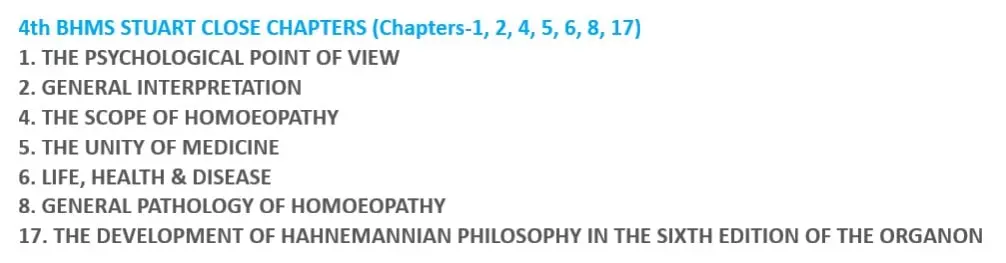
- FQ: Philosophy of Homoeopathy- Describe its principle, explanation, classification and Theory.
- SFQ: Scopes of homoeopathy according to Stuart Close
- SN: Relation of Pathology with Homoeopathy
- SN: Unity of medicine
J. T. Kent (Chapters – 18 to 22)
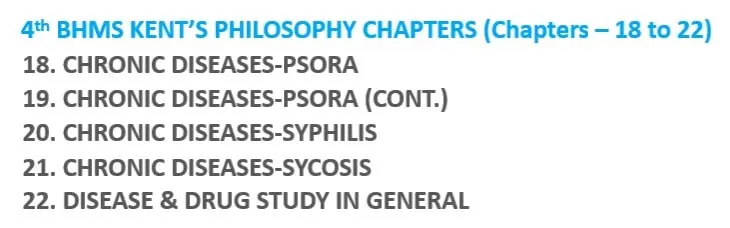
- SN: Chronic Miasms
- SN: Psora according to Kent
H. A. Roberts (Chapters- 1 to 5, 20, 22 to 33, 35)
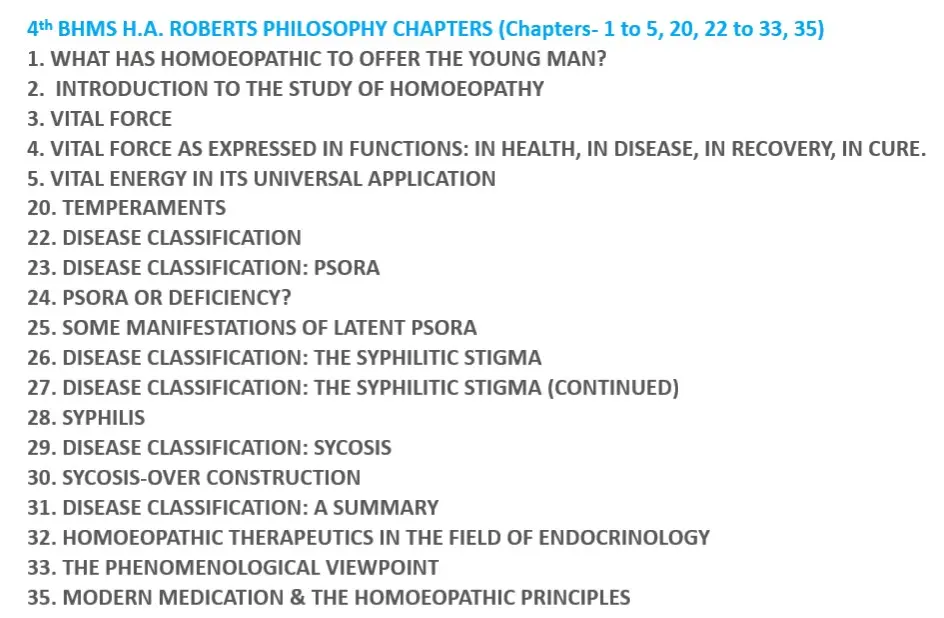
- FQ: Describe in detail about the classification of disease according to H.A. Roberts
- FQ: Discuss H.A. Robert’s phenomenological view in relation to homoeopathy.
- FQ: Narrate the role of homoeopathy in the field of endocrinology according to H.A. Roberts.
- SN: Manifestations of Latent Psora
- SN: Psora or deficiency according to Roberts.
- SN: Temperaments
Richard Hughes (Chapters-1 to 10)
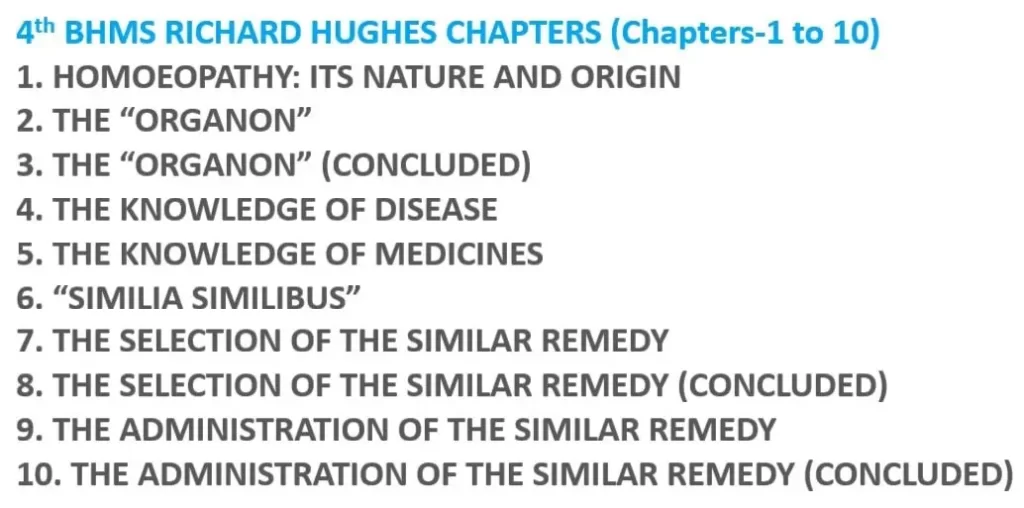
- FQ: Describe the concept of Miasm as per Dr. Richard Hughes.
- FQ: Discuss the basic concepts of homoeopathy as per Richard Hughes.
- FQ: Discuss the elements of similarity in order to selection of similar remedy.
- SN: Generic similarity
- SN: Individual similarity
- SN: Specific similarity
Carol Dunham (Chapters-1 to 7)
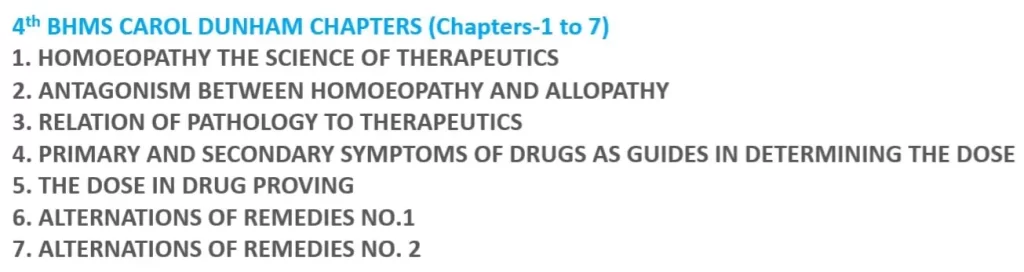
- FQ: “Homoeopathy is the science of therapeutics”-Justify this statement in the light events of the nature and elements of natural science.
- FQ: Discuss the different actions of drugs on human beings. Why it is not easy to prove the drug substances on healthy individuals?
- FQ: Discuss the relation of Pathology to Therapeutics.
- FQ: What is alternation of remedy? Discuss in detail. Why alternation of remedies is not admirable in homoeopathy?
4. CHRONIC DISEASES
- Hahnemann’s Theory of Chronic Diseases.
- H. Allen’s Chronic Miasms- Psora and Pseudo-psora; Sycosis.
- FQ: Define Chronic disease. What are the primary manifestations of chronic miasm? How should you treat according to Dr. Hahnemann? What do you understand by Secondary manifestation?
- FQ: Define Miasm. What are its types? What is its role in Acute diseases? Give few examples of Miasmatic manifestations.
- FQ: Discuss Psora theory of chronic diseases.
- FQ: How Dr. Hahnemann arrived at the theory of Chronic disease?
- FQ: In this era of Bacteriology, does Hahnemann’s Psora, Syphilis and Sycosis still hold good? If yes, why so? If not, Why not?
- FQ: What are chronic Miasms? Mention the name of the oldest. How do they develop? What are Its primary and secondary manifestations?
- FQ: What are Miasms? What are its types? Write at least 5 signs and symptoms of mental and physical generals of each miasm.
- FQ: What do you mean by secondary and latent state of chronic miasm? Write down the secondary manifestations of syphilis in eye, ear and nose.
- FQ: What is Miasm? How Dr. Hahnemann classified them? Write down Cardiac and Respiratory symptoms of psora, syphilis and sychotic miasm in detail.
- FQ: What is Psora? Draw a sketch of its evolution up to the present time. Write 5 symptoms of secondary Psora.
- FQ: What is sycosis? Discuss its manifestations and procedure of treatment.
- FQ: Which Miasm is called destructive Miasm? What is its incubation period? What are its primary and latent manifestations?
- SFQ: Explain the relation of pathogenic organisms with the Miasm.
- SFQ: What do you mean by venereal and non-venereal chronic miasm? Why Dr. Hahnemann called Psora hydra-headed?
- SFQ: What is Miasm? Distinguish between Miasmatic diagnosis and Nosological diagnosis.
- SN: Accessory symptoms of cow pox.
- SN: Anti-Miasmatic treatment
- SN: Fixed Miasm
- SN: Half spiritual miasm
- SN: Hydra-headed monster
- SN: Latent symptoms of syphilis.
- SN: Miasm behind psoriasis
- SN: Primary manifestations of three chronic Miasms.
- SN: Pseudo-psora
- SN: Scope of anti-Miasmatic treatment during pregnancy.
MISCELLANEOUS
- SFQ: ‘Homoeopathy is a Science and also Art’- Justify this statement.
- SN: ‘Homoeopathy treats the patient not the disease’- Discuss this statement.
- SN: Diagnosis and its importance from homoeopathic view point.
- SN: Distinguish between Anamnesis and Diagnosis.
- SN: Importance of Anamnesis with its objectives.
- SN: Importance of Diagnosis in general.
- SN: Remarks of Hahnemann on surgical diseases.
- SN: Role of Homoeopathy in surgical diseases.
- SN: Scope of homoeopathy in Immunology.
- SN: What is Anamnesis? Discuss the method of anamnesis.
Hope that you find this post helpful for your upcoming examinations.
You may also find useful content of other subjects of 4th B.H.M.S. by following the below mentioned links,
📌 Clarification for Students (Please Read)
Many students are asking about word limits and marks for FQ (Full Question), SFQ (Semi-Full Question), and SN (Short Note).
👉 Important to understand:
This guide is NOT based on any one university’s paper pattern.
Across India, exam patterns, marks, and word limits vary from university to university, and even from year to year. Some universities don’t strictly follow the terms FQ, SFQ, or Short Notes at all.
🔹 Why this guide is made this way?
I have classified topics as Full Question / Semi-Full Question / Short Note only to help you understand:
Depth of preparation needed
How important the topic is
How much content is sufficient to write confidently in any exam
🔹 How to use this practically in exams?
If a topic is marked as Full Question → you should be able to write a detailed, complete answer
If it is Semi-Full Question → write a moderately detailed answer
If it is a Short Note → write key points, definitions, and important headings
📌 If you prepare the material as mentioned in this guide, you will be able to adjust your answer to any university’s paper style and score well.
This guide is made to simplify preparation and reduce confusion, not to restrict you to any fixed word limit.
Happy studying 🌱
Prepare smart, not stressed.
i want philosophy notes.. Plz help me
Why psora is hydra headed?
I need answer
I want philosophy nots
Don’t forget to subscribe the site so you can not miss the upcoming updates.
I want philosophy notes