
Chronic disease is one of the greatest unsolved puzzles of modern medicine.
People across the world ask the same painful questions:
- “Why does my illness keep coming back?”
- “Why do symptoms change, but I’m never truly well?”
- “Why are my reports normal, yet I feel unwell?”
Modern medicine often explains disease in terms of organs, chemicals, or isolated causes.
Homeopathy looks deeper—and finds answers through the concept of miasms.
Miasms are not germs.
They are not infections.
They are deep, inherited or acquired patterns of imbalance that decide how disease starts, how it progresses, and why it becomes chronic.
In simple words:
Miasms are the background tendencies that shape how your body reacts to life.
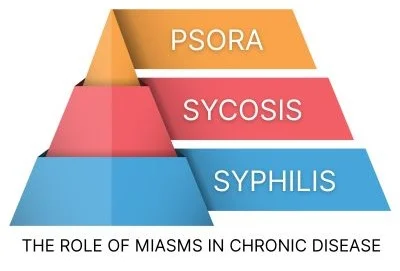
Table of Contents
ToggleWhat Does the Word “Miasm” Mean?
The word miasm comes from the Greek word “míasma”, meaning:
“Pollution,” “Taint,” Or “Deep Contamination”
In the 18th and early 19th centuries, before bacteria were discovered, diseases were believed to arise from invisible influences that disturbed the body’s internal harmony.
Dr. Samuel Hahnemann, the founder of homeopathy, did not use the word miasm to mean infection.
He used it to describe a deep-seated disease tendency that persists even after symptoms disappear.
This was a revolutionary idea.
Hahnemann observed that:
- Patients improved temporarily
- Symptoms returned in new forms
- Treatments that worked once stopped working
- Disease seemed to “shift,” not heal
He realised something fundamental was being missed.
Historical Background: How Miasm Theory Was Discovered
Hahnemann’s greatest challenge was chronic disease.
Acute illnesses often responded beautifully to homeopathic remedies.
Chronic diseases did not.
Even after correct remedies:
- Skin rashes disappeared → asthma appeared
- Headaches improved → joint pains started
- Digestive issues settled → anxiety increased
Instead of cure, disease changed its expression.
Through decades of observation, Hahnemann concluded:
“There must be a deeper cause behind chronic disease—something that survives symptom removal.”
This led him to write his monumental work:
“The Chronic Diseases” (1828)
In this work, he described three fundamental miasms that underlie nearly all chronic illness:
- Psora
- Sycosis
- Syphilis
These are not diagnoses.
They are patterns of disease evolution.
What Is a Miasm?
A miasm is like a blueprint of vulnerability inside the body.
Imagine two people exposed to the same stress:
- One recovers easily
- The other becomes chronically ill
Why?
Because their internal response patterns are different.
That internal pattern is what homeopathy calls a miasm.
Miasms explain:
- Why disease becomes chronic
- Why suppression worsens illness
- Why symptoms shift instead of healing
- Why treatment needs time and depth
Initially, miasms cause functional disturbance (no visible damage).
If ignored or suppressed, they can later lead to structural disease.
How Miasms Are Applied in Homeopathic Treatment
Miasms are not treated directly.
They are understood and addressed through remedy selection.
In practice, miasmatic understanding helps a homeopath:
- Choose deeper-acting remedies
- Understand relapse patterns
- Decide potency and repetition
- Avoid superficial prescribing
- Respect the pace of healing
Homeopathy treats layers:
- Surface symptoms first
- Deeper tendencies gradually
- Without force or suppression
This is why cure takes time—but is more lasting.
Understanding Psora, Sycosis, and Syphilis
How Chronic Disease and Human Behaviour Are Shaped from Within**
Chronic disease is not random.
It follows a pattern.
Homeopathy explains this pattern through miasms — deep tendencies that influence how the body falls ill, how the mind reacts, and how a person copes with life.
Miasms are not germs or infections.
They are functional blueprints of imbalance that determine:
- Why disease becomes chronic
- Why symptoms change form but never fully disappear
- Why two people react completely differently to the same stress
Let us understand the three fundamental miasms — Psora, Sycosis, and Syphilis — as living human states, not just medical theories.
PSORA — The Miasm of Functional Imbalance and Struggle
Psora is the oldest, most common, and most fundamental miasm.
It represents a state where:
- The body is disturbed
- But still capable of adapting and compensating
In very simple words:
Psora is imbalance without destruction.
Physical expression of Psora
Psoric illness is mostly functional — meaning symptoms exist, but investigations often look normal.
Common psoric conditions include:
- Allergies
- Skin rashes and itching
- Early-stage asthma
- IBS and digestive sensitivity
- Anxiety and stress intolerance
- Hormonal sensitivity
- Chronic fatigue
- Sleep disturbances
Patients often say:
“I feel unwell, but nothing shows on tests.”
This is not imagination.
It is the body struggling to maintain balance.
Psychological pattern of Psora
Psora lives in insecurity mixed with hope.
The person feels challenged by life, but still believes improvement is possible.
How a psoric person thinks:
- Constant mental activity
- Worrying about small details
- “What if?” thinking
- Overthinking without resolution
- High sensitivity to criticism
Inner feeling:
“I’m trying my best, but it’s never enough.”
Speech pattern
- Talks quickly or nervously
- Explains too much
- Apologises often
- Asks many questions
- Seeks reassurance
Speech reflects uncertainty and restlessness.
Appearance & behaviour
- Simple, practical clothing
- Comfort over style
- Often looks rushed or slightly untidy
- Hardworking but easily fatigued
- Responsible, avoids conflict
- Tries to please others
Emotional expression
- Anxiety
- Self-doubt
- Fear of failure
- Guilt
- Sensitivity
Psora lives in a state of:
“I am lacking, but I must keep trying.”
What happens when Psora is suppressed?
When psoric symptoms are repeatedly ignored or forcibly suppressed:
- The body loses its natural outlet
- Disease moves deeper
- Stronger miasms begin to express
Psora is the soil on which deeper disease grows.
SYCOSIS — The Miasm of Excess, Control, and Accumulation
Sycosis develops when the body overcompensates instead of merely struggling.
Here, imbalance turns into excess.
In simple words:
Sycosis is the miasm of “too much.”
Physical expression of Sycosis
Sycotic diseases are marked by growth, retention, and accumulation.
Common sycotic conditions include:
- PCOS
- Fibroids
- Warts
- Cysts
- Obesity
- Fluid retention
- Chronic inflammation
- Hormonal excess
The body’s message is:
“I will cope by storing, building, or compensating.”
Psychological pattern of Sycosis
Sycosis develops when openness feels unsafe.
The person learns to hide, control, and manage.
How a sycotic person thinks:
- Strategic and calculated
- Focus on security and control
- Fear of exposure
- Constant comparison
- “I must handle this myself”
Inner belief:
“If people really see me, I’ll be judged.”
Speech pattern
- Controlled and measured
- Avoids emotional disclosure
- Minimises complaints
- Withholds details
- Reveals information slowly
They rarely tell the full story at once.
Appearance & behaviour
- Well-groomed
- Structured or formal clothing
- Desire to look composed
- Highly functional and productive
- Appears confident
- Hides weakness carefully
Appearance becomes a protective mask.
Emotional expression
- Suppressed guilt
- Shame
- Fear of judgment
- Emotional secrecy
- Resentment
Sycosis lives in a state of:
“I must hide this and manage it alone.”
This inner pressure explains why sycotic diseases involve excess tissue, growths, and congestion.
SYPHILIS — The Miasm of Destruction and Collapse
Syphilis represents the deepest level of chronic disease.
Here, the body’s ability to compensate is exhausted.
In simple words:
Syphilis is the miasm of breakdown and destruction.
Physical expression of Syphilis
Syphilitic disease patterns are progressive and destructive.
Common expressions include:
- Autoimmune disorders
- Degenerative diseases
- Ulceration
- Bone destruction
- Progressive neurological illness
- Severe mental illness
Psychological pattern of Syphilis
Hope collapses.
The person feels something is irreversibly broken.
How a syphilitic person thinks:
- Black-and-white thinking
- Catastrophic conclusions
- “Nothing will change”
- Deep self-blame
- Thoughts of destruction or escape
Inner feeling:
“What’s the point of continuing?”
Speech pattern
- Harsh or absolute language
- Final statements
- Either very withdrawn or explosively intense
- Sometimes brutally honest
Words often carry despair or aggression.
Appearance & behaviour
- Either neglected and careless
- Or dark, rigid, severe clothing
- Little concern for appearance
- Withdrawal from relationships
- Risk-taking or self-destructive habits
Appearance mirrors inner collapse.
Emotional expression
- Hopelessness
- Despair
- Rage turned inward
- Emotional numbness
- Suicidal thoughts
Syphilis lives in a state of:
“Something is fundamentally broken.”
This is not weakness — it is the result of long-standing unresolved imbalance, often carried across generations.
Why Miasms Matter in Chronic Disease
Without miasmatic understanding:
- Treatment becomes symptom-based
- Relief is temporary
- Disease keeps changing form
Miasms explain:
- Why one remedy works and then fails
- Why patients relapse
- Why true cure is gradual
Homeopathy does not fight disease.
It guides the body back toward balance, layer by layer.
Why This Concept Touches the Heart of Homeopathy
Miasms teach us that:
- Disease is not the enemy
- Symptoms are communication
- Suppression is not healing
- Cure is a journey, not an event
For patients, this brings relief:
“There is a reason my illness behaves this way.”
For homeopaths, this brings responsibility:
“I must treat depth, not appearances.”
Frequently Asked Questions (FAQs)
Are miasms genetic?
- They can be inherited, acquired, or both. They reflect inherited tendencies as well as life influences.
Can one person have all three miasms?
- Yes. Most chronic cases involve a combination, with one usually dominant.
Are miasms outdated theory?
- No. They are clinically observable patterns that explain disease progression better than symptom-only models.
Can miasms be cured?
- They are not “removed,” but neutralised and balanced through correct homeopathic treatment over time.
Final Thought
Psora struggles.
Sycosis controls.
Syphilis collapses.
Each miasm is a human response to stress and survival, expressed through body, mind, and behaviour.
Miasms are not abstract philosophy.
They are living clinical realities.
They teach patience.
They teach humility.
They teach respect for the body’s intelligence.
Homeopathy stands apart because it asks a deeper question:
“What is the body trying to express—and why?”
Miasms help us listen.