
For centuries, homeopathy has sparked both deep devotion and sharp skepticism.
While critics dismiss it as pseudoscience or a mere placebo, millions of people across the world continue to experience what they describe as life-changing results. So, what’s the truth?
Is homeopathy just a glorified sugar pill with no medicinal value? Or is there something deeper at work—something that science has yet to fully understand?
Over the years, I have observed remarkable improvements in many patients receiving individualized homeopathic treatment.
While personal clinical observations are valuable for generating hypotheses, they do not replace evidence from well-designed scientific studies. Both clinical experience and scientific research contribute to the ongoing discussion about homeopathy’s effectiveness.
From chronic illnesses to emotional breakthroughs, I’ve seen patients recover in ways that go beyond what most people expect from “placebo.”
But I also respect science. And I understand why so many question homeopathy’s effectiveness—especially when some studies show inconclusive results or struggle to explain how ultra-diluted remedies can work.
In this article, we’ll take a closer look at this ongoing debate.
We’ll explore what science really says, highlight key criticisms from the medical community, and share powerful real-world experiences from patients and practitioners.
Whether you’re a skeptic, a curious mind, or a believer, this comprehensive guide will help you form a well-rounded, informed perspective on the effectiveness of homeopathy.
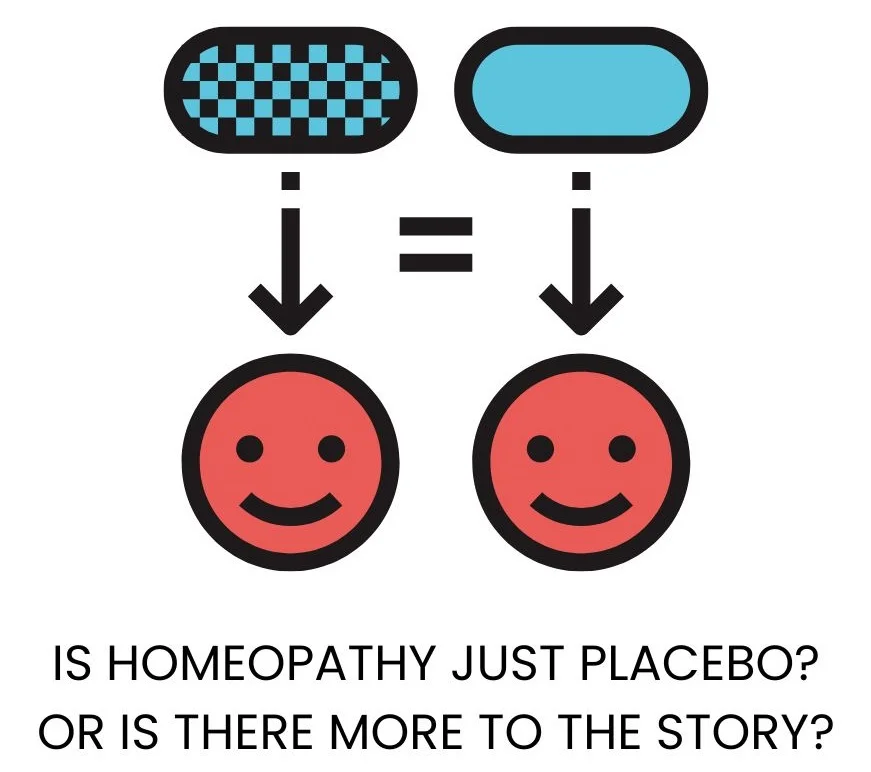
Table of Contents
ToggleWhat is Homeopathy?
Homeopathy is a 200+ year old medical system founded by Dr. Samuel Hahnemann.
Based on the principle of “like cures like” and the concept of potentization, homeopathic remedies aim to stimulate the body’s self-healing mechanism.
- Like cures like: A substance that causes symptoms in a healthy person can treat similar symptoms in a sick person.
- Potentization: Through serial dilution and succussion (vigorous shaking), remedies are believed to retain the energetic imprint of the original substance.
Homeopathy is widely practiced in Europe, India, and many other parts of the world, despite ongoing skepticism from certain scientific communities.
What Is a Placebo, really?
In conventional medicine, a placebo is an inactive substance (like a sugar pill) given to a patient. The patient might feel better due to their expectation that the treatment will work. This is called the placebo effect.
But here’s the twist: The placebo effect is present in all forms of medicine—yes, even allopathic medicine. It’s a powerful demonstration of the mind-body connection.
Why Homeopathy Is Accused of Being a Placebo
- Ultra-diluted medicines: Critics argue that since homeopathic remedies are diluted beyond Avogadro’s number, there’s no material substance left.
- No conventional explanation: Mainstream science hasn’t fully explained how remedies work on an energetic or informational level.
- Delayed scientific recognition: Homeopathy often operates outside the lens of conventional biomedical models.
But does lack of understanding mean it doesn’t work?
Let’s not stop here. Let’s look deeper.
What Does Scientific Research Say About Homeopathy?
Scientific research on homeopathy has produced mixed findings, making it one of the most debated areas in complementary medicine.
Some studies, observational research, and health technology assessments have reported positive outcomes for certain conditions or suggested that homeopathy may offer benefits beyond placebo.
For example, the Swiss Health Technology Assessment (HTA) concluded that homeopathy showed promising evidence for safety and potential effectiveness in selected clinical situations.
Similarly, some researchers, including Dr. Klaus Linde, have published analyses suggesting that the observed effects of homeopathy cannot always be explained by placebo alone.
However, many systematic reviews and meta-analyses have reached different conclusions.
Several have found that the overall evidence is insufficient or inconsistent to demonstrate that homeopathy performs better than placebo across most medical conditions.
Differences in study design, small sample sizes, publication bias, and methodological limitations contribute to these conflicting findings.
Rather than proving or disproving homeopathy completely, the current scientific literature reflects an ongoing debate.
More rigorous, well-designed, and reproducible research is still needed to better understand where homeopathy may be beneficial and where its limitations lie.
Why Does Scientific Debate Continue?
One of the main reasons homeopathy remains controversial is that its principles differ significantly from conventional pharmaceutical research.
Several factors contribute to the ongoing scientific debate:
- Homeopathic treatment is individualized, meaning two patients with the same diagnosis may receive different remedies.
- Many clinical trials evaluate standardized treatments rather than individualized prescriptions, making study design challenging.
- Sample sizes in some homeopathic studies are relatively small.
- Results have not always been consistently reproduced across different trials.
- Systematic reviews often include studies of varying quality, leading to different interpretations.
For these reasons, researchers continue to investigate homeopathy while discussing the most appropriate methods for evaluating individualized treatments.
If It’s Just a Placebo, Why Do So Many People Get Better?
Let’s face it—millions of people use homeopathy globally.
From allergies and hormonal imbalances to autoimmune diseases and mental health, patients report long-term relief.
Here are a few real-world reasons why homeopathy often works even if critics dismiss it:
- Holistic approach: Homeopathy treats the person, not just the disease. This deeper personalization itself has therapeutic value.
- Time and attention: Homeopathic consultations often last 45–90 minutes. Patients feel heard, which supports healing.
- Mind-body connection: Emotional healing often precedes physical healing in homeopathy.
Even if placebo were involved to some degree, the results are very real for patients.
Patient Experiences That Cannot Be Ignored
Let me share some examples:
- One family reported gradual improvements in their child’s sleep, behaviour, attention, and overall quality of life during individualized homeopathic care. While such clinical experiences are meaningful to practitioners and families, they should be interpreted cautiously and cannot establish cause and effect without well-designed clinical studies.
- One patient with chronic psoriasis reported significant improvement following individualized homeopathic treatment after conventional therapies had provided limited relief. Individual case experiences are valuable in clinical practice but should not be interpreted as proof that the same results will occur in every patient.
- An anxious teenager who transformed emotionally and academically after Ignatia and Kali Phos.
Placebo can’t explain deep emotional catharsis, improved family dynamics, or transformations that occur in non-verbal children or animals.
Why Is Homeopathy Difficult to Study in Clinical Trials?
Studying homeopathy presents unique challenges because it differs from conventional medical treatment in several important ways.
Unlike conventional medicine, where many patients with the same diagnosis receive the same drug, homeopathy emphasizes individualization. Two people with identical medical conditions may receive entirely different homeopathic remedies depending on their complete symptom picture, personality, medical history, and constitutional characteristics.
This individualized approach makes it difficult to design large randomized clinical trials using conventional pharmaceutical research methods.
Additional challenges include:
- Individualized prescriptions rather than standardized treatment.
- Longer consultation times.
- Variations in practitioner experience.
- Complex patient characteristics.
- Difficulty blinding individualized treatments.
These challenges do not invalidate research but highlight why evaluating homeopathy requires carefully designed studies.
Understanding the Placebo Effect
The placebo effect refers to measurable improvements that occur because a person expects a treatment to help, even when the treatment itself has no known active therapeutic ingredient.
Importantly, the placebo effect is not unique to homeopathy. It has been observed in many areas of healthcare, including conventional medicine, surgery, and clinical drug trials.
Factors that may contribute to placebo responses include:
- Positive expectations.
- Strong doctor-patient relationships.
- Reduced anxiety.
- Increased attention to symptoms.
- Natural fluctuations in disease.
Because placebo effects occur across medicine, researchers continue to investigate whether homeopathy produces effects beyond placebo. At present, scientific opinions remain divided, and further high-quality research is needed.
Critics vs. Practitioners – Why the Divide Exists
Critics demand double-blind RCTs. Practitioners witness miracles in their clinic rooms. Here’s why the gap exists:
- Homeopathy is individual-specific. Two people with migraines may need different remedies. This doesn’t align with RCT models that treat all patients as similar.
- Chronic cases take time. Trials lasting 3–6 weeks may not capture the full effect.
- Healing crisis (initial aggravation) is often misjudged as failure.
So, the tools of conventional science may be too narrow to evaluate a system that works holistically.
Can Science Explain How Homeopathy Works?
Researchers have proposed several scientific hypotheses that may help explain certain observations associated with highly diluted homeopathic medicines.
Some of the most frequently discussed theories include:
- Nanoparticle hypothesis.
- Water structure or water memory hypothesis.
- Physicochemical changes during potentization.
- Epigenetic influences.
- Hormesis.
Although these ideas continue to be explored, none has yet achieved broad scientific consensus as an established explanation for the mechanism of action of homeopathic medicines. Ongoing laboratory and clinical research aims to better understand these possibilities.
What Should You Believe?
Instead of falling for either extreme—”It’s a scam” or “It’s magic”—approach homeopathy with an open but critical mind:
- Try it under the supervision of a qualified practitioner.
- Track changes emotionally and physically.
- Respect the individuality of treatment and healing timeline.
Remember: Healing is not just chemical. It’s emotional, spiritual, and energetic too.
Why Do Millions of Patients Continue Choosing Homeopathy?
Despite scientific debate, millions of people around the world continue to seek homeopathic treatment for a variety of health concerns.
Some commonly reported reasons include:
- Individualized treatment tailored to each patient.
- Longer consultation times.
- Holistic approach that considers physical, mental, and emotional health.
- Generally gentle treatment philosophy.
- High levels of patient satisfaction reported in some observational studies.
- Preference for complementary and integrative healthcare.
Choosing homeopathy is a personal healthcare decision and should ideally be made in consultation with a qualified healthcare professional, particularly for serious or emergency medical conditions.
Key Takeaways
- Homeopathy remains one of the most debated systems of medicine.
- Scientific research has produced mixed findings, with some studies reporting positive results and others finding insufficient evidence beyond placebo.
- Individualized prescribing makes homeopathy difficult to evaluate using conventional clinical trial designs.
- Millions of patients continue to choose homeopathy because of its personalized and holistic approach.
- The exact mechanism of action of highly diluted homeopathic medicines remains an active area of scientific research.
- Homeopathy should complement—not replace—appropriate emergency or evidence-based medical care when required.
Frequently Asked Questions
Is homeopathy scientifically proven?
Scientific evidence on homeopathy is mixed. Some studies have reported positive findings, while many systematic reviews conclude that the overall evidence is insufficient to demonstrate effectiveness beyond placebo for most medical conditions. Research continues in this area.
Is homeopathy only a placebo?
The placebo effect may contribute to symptom improvement in any medical treatment, including conventional medicine. Whether homeopathy has effects beyond placebo remains a topic of ongoing scientific debate.
Why do some people report improvement with homeopathy?
Patients may report improvement for many reasons, including individualized care, the natural course of illness, placebo responses, lifestyle changes, and, according to some practitioners and researchers, potential therapeutic effects of homeopathic medicines.
Why is homeopathy controversial?
Homeopathy is controversial because its principles differ from conventional pharmacology, and scientific studies have produced conflicting results regarding its effectiveness.
Can homeopathy replace emergency medical treatment?
No. Homeopathy should not replace emergency medical care or treatments that have strong evidence of benefit for serious or life-threatening conditions. It should be used under the guidance of a qualified healthcare professional.
Is homeopathy safe?
Homeopathic medicines are generally considered low risk when manufactured according to recognized quality standards and used appropriately. However, safety also depends on correct diagnosis, appropriate prescribing, and avoiding delays in necessary conventional treatment for serious illnesses.
Beyond the Placebo Debate
Homeopathy may not fit into the mainstream scientific mold, but that does not negate its value.
With thousands of healed patients, emerging scientific curiosity, and a deeper holistic philosophy, homeopathy deserves more than just being labelled placebo.
Is it time we widen our definition of science to include what we’ve yet to fully understand?